
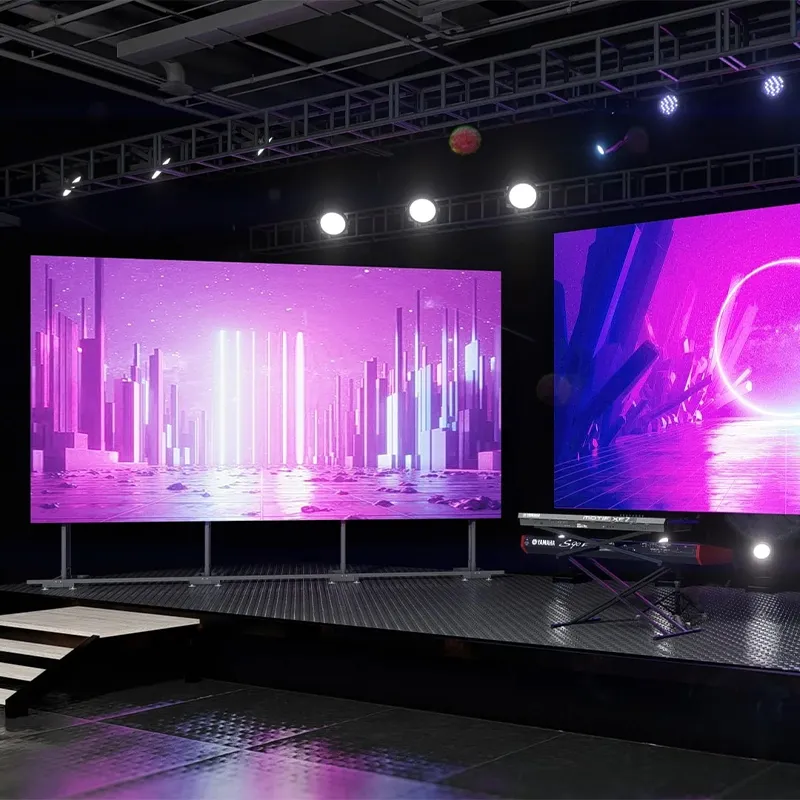
P2.5 vs P1.86 Indoor LED Display: Which One Is Better for Your Business in Malaysia?
When a business starts planning a large indoor display, one of the first specifications that appears in the quotation is the pixel pitch.
You may see terms such as P2.5, P2, P1.86 or P1.5.
For someone who is not familiar with LED display technology, these numbers can be confusing. Does P1.86 automatically mean it is better than P2.5? Is the additional investment worth it? Which one should a school, hotel, business, church or recreation centre choose?
The answer depends largely on viewing distance, screen size, content, room design and budget.
For many large indoor applications in Malaysia, a P2.5 indoor LED display remains a very practical choice. However, if viewers will be sitting closer to the screen or the display needs to show highly detailed graphics, a P1.86 indoor LED display may provide an advantage.
Let’s look at the differences in simple terms.
What Does P2.5 and P1.86 Mean?
The number represents the pixel pitch.
Pixel pitch is approximately the distance between neighbouring LED pixels.
P2.5
P2.5 has approximately a 2.5mm pixel pitch.
It is commonly used for larger indoor displays where the audience is several metres away.
P1.86
P1.86 has approximately a 1.86mm pixel pitch.
Because the pixels are closer together, more pixels can fit into the same physical area.
This allows the display to produce more detail, particularly when viewed from a shorter distance.
A simple way to understand it is:
P2.5 → larger pixel spacing
P1.86 → smaller pixel spacing
Therefore, P1.86 generally provides higher pixel density for the same physical screen size.
But that does not mean P1.86 is always the better purchase.
Is P1.86 Always Better Than P2.5?
Technically, P1.86 can provide greater pixel density.
But from a buyer’s perspective, the question should be:
“Do I actually need the additional pixel density?”
If the audience is sitting far away from the display, the difference may not justify the additional investment.
For example, imagine a school hall where the furthest audience members are sitting 20 metres away.
A properly designed P2.5 LED display can already provide an excellent viewing experience.
Spending significantly more for P1.86 may not create enough practical improvement to justify the additional cost.
On the other hand, if the display is installed in a corporate boardroom where people sit only 3–5 metres away, P1.86 becomes much more attractive.
P2.5 Indoor LED Display: Where Does It Work Best?
P2.5 is particularly suitable for larger indoor environments.
Typical applications include:
School Halls
Schools can use P2.5 displays for:
- Assemblies
- Graduation ceremonies
- Performances
- Award ceremonies
- Presentations
- Sports events
- School announcements
Hotels
Hotels can use LED displays for:
- Weddings
- Conferences
- Product launches
- Corporate events
- Stage backgrounds
- Ballroom presentations
Churches and Religious Venues
Large LED displays can be used for:
- Lyrics
- Video
- Presentations
- Live camera feeds
- Event announcements
Recreation Centres
A recreation centre can use a large LED display for:
- Sports competitions
- Live scores
- Training videos
- Fitness classes
- Promotional content
- Gaming
- Events
Corporate Training Centres
P2.5 can also be used in larger training rooms where many participants need to see the same content.
P1.86 Indoor LED Display: When Does It Make More Sense?
P1.86 becomes particularly attractive when the display is intended to be viewed from a relatively close distance.
Examples include:
- Executive boardrooms
- Premium conference rooms
- Control rooms
- Corporate experience centres
- Showrooms
- Retail environments
- High-end training rooms
- Museums and exhibitions
- High-resolution presentation environments
It can also be beneficial where the content contains a lot of detail.
For example:
- Detailed product images
- Engineering drawings
- Architectural graphics
- Charts
- Small text
- High-resolution photographs
- Detailed video content
P2.5 vs P1.86: A Simple Comparison
| Feature | P2.5 | P1.86 |
|---|---|---|
| Pixel pitch | 2.5mm | 1.86mm |
| Pixel density | Lower | Higher |
| Image detail | Very good | Excellent |
| Close viewing | Good | Better |
| Large halls | Excellent | Excellent |
| Boardrooms | Good | Excellent |
| Large screen | Excellent | Excellent |
| Investment | Generally lower | Generally higher |
| Best use | Large indoor venues | Premium / closer viewing |
The exact price and performance depend on the LED chip, module design, cabinet, driver IC, refresh rate, brightness and other components.
Don’t Choose LED Based on Pixel Pitch Alone
This is one of the biggest mistakes buyers make.
A quotation might say:
P2.5 Indoor LED Display
But that specification alone doesn’t tell you everything about the display.
You should also ask about:
LED Chip
The quality and consistency of the LED components affect colour, brightness and long-term performance.
Refresh Rate
A higher refresh rate can be particularly important when the LED screen is being recorded by cameras.
This matters for:
- Live events
- Streaming
- Television production
- Video recording
- Corporate events
Brightness
Indoor LED displays do not necessarily need the same brightness levels as outdoor LED billboards.
The supplier should select the brightness according to the actual environment.
Cabinet Design
The cabinet affects:
- Installation
- Maintenance
- Alignment
- Structural requirements
- Front/rear servicing
Receiving Card
The receiving card controls the LED modules and forms an important part of the display system.
Power Supply
Quality power supplies are important for long-term reliability.
LED Display vs Smart Board
It is also important not to confuse an LED display with a Smart Board.
They serve different purposes.
A Smart Board is primarily designed for:
- Interactive writing
- Teaching
- Meetings
- Training
- Collaboration
- Touch interaction
- Annotation
- Web browsing
An LED display is primarily designed for:
- Large-scale viewing
- Presentations
- Video
- Events
- Digital content
- Audience communication
For example, a training centre could use:
Smart Board
for the trainer to write and interact with content.
Then use:
P2.5 LED Display
as the main large display for the audience.
This combination can provide a much more flexible environment.
Why Custom LED Size Is Important
One advantage of LED technology is that you don’t have to select a standard television size.
For example, your available wall may be:
4.8m wide × 2.7m high
Instead of asking:
“Which TV size fits this wall?”
you can design an LED display around the available space.
The supplier can calculate the appropriate:
- Module arrangement
- Cabinet arrangement
- Screen ratio
- Width
- Height
- Pixel resolution
This makes indoor LED particularly useful for large halls and custom architectural environments.
Installation Should Be Part of the Purchase Decision
An LED display is not simply a product that gets delivered and plugged into a wall socket.
A professional project may require:
Site measurement
↓
LED screen design
↓
Structural design
↓
Electrical planning
↓
LED installation
↓
Video processor configuration
↓
Receiving card configuration
↓
Screen calibration
↓
Testing
↓
Commissioning
A supplier with installation experience can identify potential problems before the screen is installed.
What About After-Sales Service?
This is one of the most important questions to ask before buying.
LED displays contain many electronic components.
Over time, a module or component may require servicing.
Ask your supplier:
- Do you keep spare LED modules?
- Can you provide on-site service?
- How long is the warranty?
- Who handles technical problems?
- Are replacement power supplies available?
- Can the receiving card be replaced?
- Is calibration available?
- What happens after the warranty period?
A lower initial quotation does not necessarily mean a lower total cost of ownership.
A slightly more expensive system with strong technical support may ultimately be more economical.
Why Choose C.T.Technology (PG) Sdn Bhd?
At C.T.Technology (PG) Sdn Bhd, we provide indoor LED display solutions for organisations looking for reliable large-format visual systems.
Our available solutions include:
P2.5 Indoor LED
A practical balance between resolution, viewing distance and investment.
P1.86 Indoor LED
A higher-resolution option for closer viewing and premium applications.
P2 Indoor LED
A high-resolution option for customers looking for an additional balance between P1.86 and P2.5.
We can help customers determine which pixel pitch is suitable based on the actual environment instead of simply recommending the most expensive specification.
Which One Should You Buy?
If your project is a:
Large school hall
→ P2.5 may be an excellent choice
Hotel ballroom
→ P2.5 or P1.86 depending on viewing distance
Large church
→ P2.5 can provide an excellent balance
Corporate boardroom
→ P1.86 may be worth considering
Premium showroom
→ P1.86
Large recreation centre
→ P2.5
Detailed presentation environment
→ P1.86
However, these are general guidelines.
The correct choice should always be based on the actual room dimensions, viewing distance and content.
Final Thoughts
There is no single pixel pitch that is perfect for every project.
P2.5 indoor LED display remains a highly practical option for many large indoor applications because it offers a good balance of image quality, screen size and investment.
P1.86 indoor LED display provides greater pixel density and can be more suitable when the audience is closer to the screen or when highly detailed content is important.
The most important thing is to avoid choosing based purely on the specification printed on a quotation.
Consider the entire system:
Pixel pitch + LED quality + cabinet + receiving card + power supply + processor + structure + installation + warranty + after-sales support.
A professional LED supplier should help you evaluate all of these factors.
Looking for P2.5 or P1.86 Indoor LED Display in Malaysia?
C.T.Technology (PG) Sdn Bhd provides P2.5, P2 and P1.86 indoor LED display solutions for schools, businesses, hotels, churches, recreation centres, meeting rooms and event venues.
We can help you determine the appropriate pixel pitch, screen size, viewing distance and installation requirements for your project.
📞 Contact C.T.Technology (PG) Sdn Bhd: 016-422 4178
Contact us to request more information about our Indoor LED Display solutions, including P2.5 and P1.86 high-resolution LED displays, installation and long-term technical support
When a business starts planning a large indoor display, one of the first specifications that appears in the quotation is the pixel pitch.
You may see terms such as P2.5, P2, P1.86 or P1.5.
For someone who is not familiar with LED display technology, these numbers can be confusing. Does P1.86 automatically mean it is better than P2.5? Is the additional investment worth it? Which one should a school, hotel, business, church or recreation centre choose?
The answer depends largely on viewing distance, screen size, content, room design and budget.
For many large indoor applications in Malaysia, a P2.5 indoor LED display remains a very practical choice. However, if viewers will be sitting closer to the screen or the display needs to show highly detailed graphics, a P1.86 indoor LED display may provide an advantage.
Let’s look at the differences in simple terms.
What Does P2.5 and P1.86 Mean?
The number represents the pixel pitch.
Pixel pitch is approximately the distance between neighbouring LED pixels.
P2.5
P2.5 has approximately a 2.5mm pixel pitch.
It is commonly used for larger indoor displays where the audience is several metres away.
P1.86
P1.86 has approximately a 1.86mm pixel pitch.
Because the pixels are closer together, more pixels can fit into the same physical area.
This allows the display to produce more detail, particularly when viewed from a shorter distance.
A simple way to understand it is:
P2.5 → larger pixel spacing
P1.86 → smaller pixel spacing
Therefore, P1.86 generally provides higher pixel density for the same physical screen size.
But that does not mean P1.86 is always the better purchase.
Is P1.86 Always Better Than P2.5?
Technically, P1.86 can provide greater pixel density.
But from a buyer’s perspective, the question should be:
“Do I actually need the additional pixel density?”
If the audience is sitting far away from the display, the difference may not justify the additional investment.
For example, imagine a school hall where the furthest audience members are sitting 20 metres away.
A properly designed P2.5 LED display can already provide an excellent viewing experience.
Spending significantly more for P1.86 may not create enough practical improvement to justify the additional cost.
On the other hand, if the display is installed in a corporate boardroom where people sit only 3–5 metres away, P1.86 becomes much more attractive.
P2.5 Indoor LED Display: Where Does It Work Best?
P2.5 is particularly suitable for larger indoor environments.
Typical applications include:
School Halls
Schools can use P2.5 displays for:
- Assemblies
- Graduation ceremonies
- Performances
- Award ceremonies
- Presentations
- Sports events
- School announcements
Hotels
Hotels can use LED displays for:
- Weddings
- Conferences
- Product launches
- Corporate events
- Stage backgrounds
- Ballroom presentations
Churches and Religious Venues
Large LED displays can be used for:
- Lyrics
- Video
- Presentations
- Live camera feeds
- Event announcements
Recreation Centres
A recreation centre can use a large LED display for:
- Sports competitions
- Live scores
- Training videos
- Fitness classes
- Promotional content
- Gaming
- Events
Corporate Training Centres
P2.5 can also be used in larger training rooms where many participants need to see the same content.
P1.86 Indoor LED Display: When Does It Make More Sense?
P1.86 becomes particularly attractive when the display is intended to be viewed from a relatively close distance.
Examples include:
- Executive boardrooms
- Premium conference rooms
- Control rooms
- Corporate experience centres
- Showrooms
- Retail environments
- High-end training rooms
- Museums and exhibitions
- High-resolution presentation environments
It can also be beneficial where the content contains a lot of detail.
For example:
- Detailed product images
- Engineering drawings
- Architectural graphics
- Charts
- Small text
- High-resolution photographs
- Detailed video content
P2.5 vs P1.86: A Simple Comparison
| Feature | P2.5 | P1.86 |
|---|---|---|
| Pixel pitch | 2.5mm | 1.86mm |
| Pixel density | Lower | Higher |
| Image detail | Very good | Excellent |
| Close viewing | Good | Better |
| Large halls | Excellent | Excellent |
| Boardrooms | Good | Excellent |
| Large screen | Excellent | Excellent |
| Investment | Generally lower | Generally higher |
| Best use | Large indoor venues | Premium / closer viewing |
The exact price and performance depend on the LED chip, module design, cabinet, driver IC, refresh rate, brightness and other components.
Don’t Choose LED Based on Pixel Pitch Alone
This is one of the biggest mistakes buyers make.
A quotation might say:
P2.5 Indoor LED Display
But that specification alone doesn’t tell you everything about the display.
You should also ask about:
LED Chip
The quality and consistency of the LED components affect colour, brightness and long-term performance.
Refresh Rate
A higher refresh rate can be particularly important when the LED screen is being recorded by cameras.
This matters for:
- Live events
- Streaming
- Television production
- Video recording
- Corporate events
Brightness
Indoor LED displays do not necessarily need the same brightness levels as outdoor LED billboards.
The supplier should select the brightness according to the actual environment.
Cabinet Design
The cabinet affects:
- Installation
- Maintenance
- Alignment
- Structural requirements
- Front/rear servicing
Receiving Card
The receiving card controls the LED modules and forms an important part of the display system.
Power Supply
Quality power supplies are important for long-term reliability.
LED Display vs Smart Board
It is also important not to confuse an LED display with a Smart Board.
They serve different purposes.
A Smart Board is primarily designed for:
- Interactive writing
- Teaching
- Meetings
- Training
- Collaboration
- Touch interaction
- Annotation
- Web browsing
An LED display is primarily designed for:
- Large-scale viewing
- Presentations
- Video
- Events
- Digital content
- Audience communication
For example, a training centre could use:
Smart Board
for the trainer to write and interact with content.
Then use:
P2.5 LED Display
as the main large display for the audience.
This combination can provide a much more flexible environment.
Why Custom LED Size Is Important
One advantage of LED technology is that you don’t have to select a standard television size.
For example, your available wall may be:
4.8m wide × 2.7m high
Instead of asking:
“Which TV size fits this wall?”
you can design an LED display around the available space.
The supplier can calculate the appropriate:
- Module arrangement
- Cabinet arrangement
- Screen ratio
- Width
- Height
- Pixel resolution
This makes indoor LED particularly useful for large halls and custom architectural environments.
Installation Should Be Part of the Purchase Decision
An LED display is not simply a product that gets delivered and plugged into a wall socket.
A professional project may require:
Site measurement
↓
LED screen design
↓
Structural design
↓
Electrical planning
↓
LED installation
↓
Video processor configuration
↓
Receiving card configuration
↓
Screen calibration
↓
Testing
↓
Commissioning
A supplier with installation experience can identify potential problems before the screen is installed.
What About After-Sales Service?
This is one of the most important questions to ask before buying.
LED displays contain many electronic components.
Over time, a module or component may require servicing.
Ask your supplier:
- Do you keep spare LED modules?
- Can you provide on-site service?
- How long is the warranty?
- Who handles technical problems?
- Are replacement power supplies available?
- Can the receiving card be replaced?
- Is calibration available?
- What happens after the warranty period?
A lower initial quotation does not necessarily mean a lower total cost of ownership.
A slightly more expensive system with strong technical support may ultimately be more economical.
Why Choose C.T.Technology (PG) Sdn Bhd?
At C.T.Technology (PG) Sdn Bhd, we provide indoor LED display solutions for organisations looking for reliable large-format visual systems.
Our available solutions include:
P2.5 Indoor LED
A practical balance between resolution, viewing distance and investment.
P1.86 Indoor LED
A higher-resolution option for closer viewing and premium applications.
P2 Indoor LED
A high-resolution option for customers looking for an additional balance between P1.86 and P2.5.
We can help customers determine which pixel pitch is suitable based on the actual environment instead of simply recommending the most expensive specification.
Which One Should You Buy?
If your project is a:
Large school hall
→ P2.5 may be an excellent choice
Hotel ballroom
→ P2.5 or P1.86 depending on viewing distance
Large church
→ P2.5 can provide an excellent balance
Corporate boardroom
→ P1.86 may be worth considering
Premium showroom
→ P1.86
Large recreation centre
→ P2.5
Detailed presentation environment
→ P1.86
However, these are general guidelines.
The correct choice should always be based on the actual room dimensions, viewing distance and content.
Final Thoughts
There is no single pixel pitch that is perfect for every project.
P2.5 indoor LED display remains a highly practical option for many large indoor applications because it offers a good balance of image quality, screen size and investment.
P1.86 indoor LED display provides greater pixel density and can be more suitable when the audience is closer to the screen or when highly detailed content is important.
The most important thing is to avoid choosing based purely on the specification printed on a quotation.
Consider the entire system:
Pixel pitch + LED quality + cabinet + receiving card + power supply + processor + structure + installation + warranty + after-sales support.
A professional LED supplier should help you evaluate all of these factors.
Looking for P2.5 or P1.86 Indoor LED Display in Malaysia?
C.T.Technology (PG) Sdn Bhd provides P2.5, P2 and P1.86 indoor LED display solutions for schools, businesses, hotels, churches, recreation centres, meeting rooms and event venues.
We can help you determine the appropriate pixel pitch, screen size, viewing distance and installation requirements for your project.
📞 Contact C.T.Technology (PG) Sdn Bhd: 016-422 4178
Contact us to request more information about our Indoor LED Display solutions, including P2.5 and P1.86 high-resolution LED displays, installation and long-term technical support
